

Marine Oyster Organic Calcium Plastic Additive – Moocpa
Moocpa is mainly in the form of granule, and refined from ground seashells. Moocpa contains a large amount of chitin. Through high temperature and special dehydration, chitin is transformed into chitosan. Moocpa is one of important natural microscopic organisms and non-toxic. It possesses good adhesivity, biological compatibility, biodegradability and special absorbability.
It features its nanograde biodegradable plastic additive. The addition of Moocpa in a proportion of 20%~60% will change the constituents of all plastic ware. Moocpa is a 100% degradable and nontoxic substance – low carbon and low pollution. It cadmium and plasticizer. Moocpa can be used for industrial processing, waste treatment and environmental recycling. It effectively reduces carbon discharge and environmental pollution. In 2008 the second generation Moocpa was developed. It effectively increases productivity on product processing. Besides, Moocpa contains 91% high radiation of far infrared and healthy energy of negative ions, and can be used for medical care and relevant products.
Five Main Characters of Moocpa

- Non-food and utilization of waste
- Moocpa eco-friendly material is made from nonedible food (non-corn or non-potato starch).
- Moocpa is made from recycling marine wasteutilization of waste.
- Abandonment of degraded Moocpa won’t affect water or air quality, pollute soil. Burning Moocpa will not produce dioxin.
- Biodegradable
- One 0.03mm thick handbag in the outdoors can completely decompose in 3~6 months, and begins to decompose in 2 years if the same handbag is inside a building.
- In decomposition experiment of 127 days burying, the decomposition rate is over 80.6%.
- Moocpa becomes organic fertilizer after decomposition.
- Addition ratio and decomposition time are adjustable.
- Cost reduction
- It is unnecessary to replace the machine or change the manufacturing process.
- Moocpa eco-friendly material is smooth, and doesn’t damage machines or molds, but boosts productivity.
- Moocpa eco-friendly material is more inexpensive than ordinary plastic material, and reduces production costs.
- 91% far infrared
- Moocpa can be used for healthy care (such as eyeshade, mattress, clothes, etc…) to stimulate blood circulation and accelerate metabolism.
- Moocpa can be used for keeping food fresh (meat, seafood, vegetables and fruits) for a longer time.
- Moocpa can be used in tableware, cups and containers to eliminate bad tastes from food, such as being sour, salty, bitter, peppery hot, irritating, harsh, etc…
- Food-grade accreditation
- Moocpa is tested by renowned inspection companies in Europe, the USA, Taiwan and China, proved to contain no lead, mercury, cadmium or plasticizer, and has no reaction of 8 heavy metals.
- Moocpa passes the food grade packing inspection, and is non-toxin accredited.
- Moocpa withstands temperatures -20~140oC, and doesn’t discharge toxin.
- The tableware with Moocpa under SGS test: no toxin, no plasticizer or none of 8 heavy metals is detected after 2 hours of reflux in 100oC olive oil.
Biodegradable

Moocpa is not a starch based biodegradable material but from the renewable ocean shell.The agricultural film that adding 30% Moocpa would break after sun shinning.The fragment can be mixed with soil to be compostable.The residual fragment contain chitin would bite and degrade the plastics. Moocpa does not contain lead, mercury or cadmium so it has no issue of polluting soil.It does not result in mass carbonate dioxide nor methane to pollute the land so it is a environmental friendly ambassador to the earth.
Concept of biodegradation

- Step 1. Photo-degradation
- The major ingredients of Moocpa are organic calcium carbonate (CaCo3) from marine beings. The calcium carbonate melts in plastic ware. Under UV light from the sun, the plastic becomes fragile into pieces.
- Step 2. Biodegradation
- The marine organic calcium carbonate contains a large amount of chitin. Chitin under high temperature dehydration (above 100oC) produces chitosan. Chitosan melts in plastic ware where a large amount of bacteria will grow. The bacteria will nibble the plastic.
- Step 3. Moocpa photo-degradation + biodegradation
- For example: At the early stage, the plastic is coated with agricultural film over 30% Moocpa. After photo-degradation, the plastic in agricultural film contains hydroxyl which will have a chemical change under UV light from the sun. The C-H bond will be destructed, and the plastic will break and produce holes. At the later stage, it is unnecessary to recycle the debris. The debris is just rolled in soil. The under-graded agricultural film contains a large amount of chitosan where, a large amount of bacteria will grow. The bacteria continue to nibble and degrade the remaining plastic. Thus, the agricultural film can quickly and completely degrade. The complete degraded products can be used as organic fertilizer.
- Step4. Degraded products
- calcium hydroxide (CaO), water (H2O) and carbon dioxide (CO2)
Moocpa: Characters of Biodegradable Material
- Pass food-standard safety test.
- There are no lead, mercury, cadmium and plasticizer in the test of the combination of any plastic materials (PP,PE,PU,ABS) and Moocpa additive (up to 30%).
- Easy to blaze and coming out no toxic gas or dioxin during the burning.
- Excellence in breathe that is suitable for household application such as raincoat, diaper, cling film or bag is comfortable, artistic, environmentally friendly and competitive in price than related products.
- Conduct electricity free and insulation make less static electricity than general plastic productions.
- Generate no pollution during processing, no double public nuisance.
- While dumping the Moocpa products, they start to decompose after 60 to 90 days. And the ratio of Moocpa additives adjustable to meet buyers requirement on modifying degradable period.
- Biodegradation is not only influenced by sun but nature, so the degradation will function better.


Reduction of GHG EmissionS

Life cycle analysis performed by SGS, March 2012
Source
The ReCiPe method
This method uses existing characterization methods: Ecoindicator 99 and CML 2002
(ReCiPe 2008: Goedkoop,2009). http://www.Ica-recipe.net
*compensated for density difference
Strength of Moocpa Environmentally Friendly Biodegradable Material
- No additional investment.
- No machine renewal requirement.
- No difference from original function.
- Low level of carbon emission.
- No changes in strength.
- Competitive price.
- Descend the ratio of petroleum resin from 10% to 50%.
- A solution for cost saving on packing material.
- Re-use the recycled waste efficiently.
- No utilization the resource of food, land or water.
- Long expiry sustainable, no influence by temperature or humidity.
- Food test approves the contact with food.
- Temperature resistant from -45℃ to 140℃ without releasing poison.
Application of Moocpa Environmentally Friendly Biodegradation Material
1.Agricultural utilization: – cover membrane, protection membrane, nursery pot, fruit foam net and so on.

2.Disposable goods: – Garbage bag, drinking cup, coffee lids, food tray, bowl, raincoat, cutlery, glove…etc.

3.Living goods: – Remote controller, hanger, toothbrush, kettle, storage box, plastic floor…etc.

4.Stationery: – Folders, plastic ruler, pen, pencil boxes, box cutter, stapler, pen case…etc.

5.Toy: – Lego, plastic ball, models, blocks, magic box, toy’s storage box

6.Far infrared application: far infrared wine-cups, far infrared water bottles, far infrared eye masks, far infrared water-cups, far infrared salt containers, far infrared clothes, far infrared cushions, far infrared beds, far infrared insoles, far infrared fresh keepers.

Not recommend to apply Moocpa on the products that may cause hazard
-automobile parts, electrical wire, pipe, plug, plastic chairs…etc.

Far infrared
Infrared is in the spectrum out of the visible light such as red, orange, yellow, green, blue and indigo which its wavelength is beyond 0.4 to 0.75 micrometers. Infrared is able to provide warm and heat. Far infrared (wavelength 4 to 14 mm) that is called birth ray benefits people in growth, water molecule shrinkage to improve activation, resonance between molecules, histiocyte activation, blood circulation, metabolism acceleration, nutrition and enzyme supply, immunity, deodorization, humidity elimination, and anti-bacterial.
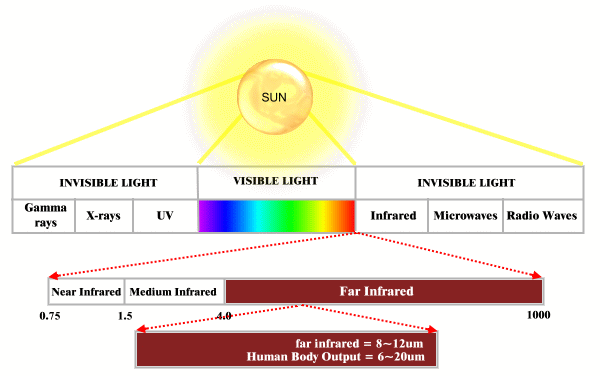
- Main characters offar infrared:
- Radiation
- Penetration
- MoleculeResonance
- What far infrared helps health?
- Enhance normoxia
- Improve micro-circulation system
- Accelerate metabolism
- Balance body PH